



Description
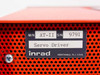
Inrad AT-II Autotracker II 2-Channel Servo Driver 120-240V Optical Motor Control
The Inrad AT-II Autotracker II is a two-channel analog servo driver designed to control DC servo motors used in precision optical positioning, laser beam tracking, and telescope mount applications. Built by Inrad (International Radiation Detectors), headquartered in Northvale, NJ, the AT-II provides independent closed-loop servo control for two axes simultaneously, with both automatic tracking and manual override modes available on each channel.
Specifications & What's Included
- Manufacturer: Inrad (Northvale, NJ, USA)
- Model: AT-II (Autotracker II)
- PCB board number: C26028
- Configuration: 2-channel servo driver
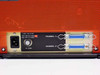
- Line voltage: 120V/60Hz or 240V/60Hz (selectable)
- Fuse: 3A
- Power input: IEC C14 inlet
- Output connectors: Two DB25-style connectors — Channel 1 and Channel 2 (rear panel)
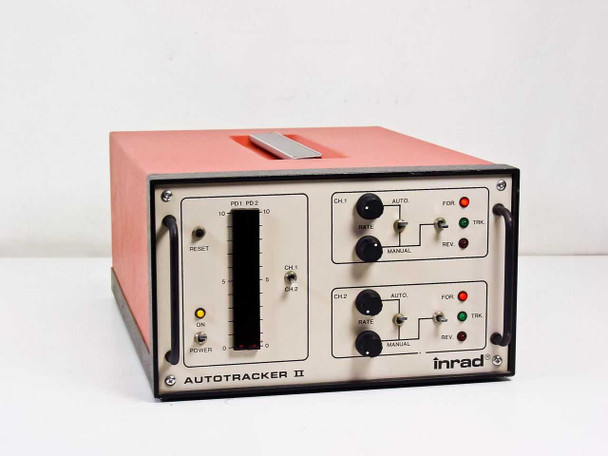
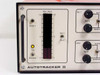
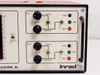
- Front panel — Channel 1 and Channel 2 each include:
- RATE control knob
- AUTO / MANUAL toggle switch
- FOR (forward), TRK (track), and REV (reverse) LED status indicators
- Dual PD1 / PD2 bargraph meters (0–10 scale) for photodetector signal display
- RESET button and POWER ON indicator (yellow LED)
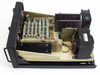
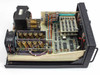
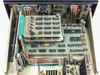
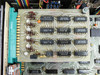
- Internal: control PCBs populated with SN74LS and HD74LS series logic ICs (Texas Instruments and Hitachi), power transformer, and resistor arrays
- Form factor: Benchtop enclosure with carry handle
- Included: Unit only — no cables or accessories
Applications
The Inrad Autotracker II was designed for precision optical beam tracking and positioning applications, particularly in research and industrial laser systems. Inrad specializes in nonlinear optical crystals and laser components, and the AT-II was developed to drive the servo motors that steer optical mounts, mirror assemblies, and telescope axes in automated tracking systems. Typical uses include laser beam steering, second-harmonic generation (SHG) crystal angle optimization, autocollimation, and telescope autoguiding. The two-channel design allows simultaneous control of two orthogonal axes (e.g., azimuth and elevation, or X and Y), making it well-suited for any application requiring closed-loop positional feedback from a two-quadrant or four-quadrant photodetector. The unit dates from the late 1980s to early 1990s based on its logic IC generation (74LS-series TTL) and DB25 interface standard, and is still sought by researchers maintaining Inrad optical systems and vintage laser labs.
This Inrad AT-II Autotracker II 2-Channel Servo Driver has been inspected and is in good used condition. It was pulled from a working environment where it was in use and functional at the time of removal. The red enclosure shows normal handling wear consistent with lab use, and the front panel controls, bargraph meters, and LED indicators all appear intact. Please view our photo set and contact us if you have any questions.
Warranty Information
Additional Information
Brand: |
Inrad |
Model: |
AT-II |
MPN: |
AT-II |
Type: |
2-Channel Servo Driver |
SKU: |
43992 |
Seller Notes: |
Unit only — no cables or accessories included. |
Country/Region of Manufacture: |
United States |
Number of Channels: |
2 |
Input Voltage: |
120V/60Hz or 240V/60Hz (selectable) |
Fuse Rating: |
3A |
Output Connector: |
DB25 (2x — Channel 1 and Channel 2) |
Power Input Connector: |
IEC C14 |
Control Modes: |
Auto / Manual (per channel) |
Display: |
Dual PD1/PD2 bargraph meters (0–10 scale) |
Channel Indicators: |
FOR / TRK / REV LEDs per channel |
Form Factor: |
Benchtop |
PCB Board Number: |
C26028 |
Application: |
Optical / telescope / laser beam servo tracking |
Condition Notes: |
This Inrad AT-II Autotracker II 2-Channel Servo Driver has been inspected and is in good used condition. Pulled from a working environment where it was in use and functional. Normal handling wear on the enclosure. |
California Prop 65 Warning: |
WARNING: This product can expose you to chemicals including lead and lead compounds, and DEHP (a phthalate), which are known to the State of California to cause cancer and birth defects or other reproductive harm. Go to P65Warnings.ca.gov |